Explore our premium range of bioactive cosmetic raw materials, engineered for superior formulation performance.
From molecular science to industrial blending — everything formulators need to know about HA.
Hyaluronic acid (HA), also known as hyaluronan, is a naturally occurring glycosaminoglycan found abundantly in the human skin, connective tissue, and synovial fluid. Its extraordinary ability to retain moisture — binding up to 1,000 times its own weight in water — has made it one of the most sought-after active ingredients in modern cosmetic science. Whether used in serums, moisturizers, sheet masks, or injectable fillers, HA occupies a central role in both mass-market and luxury skincare formulations globally.
In the context of cosmetic active ingredient formulation and blending, hyaluronic acid is far more than a simple moisturizer. It functions as a film-forming agent, a penetration enhancer, a texture modifier, and a biocompatibility booster — making it an indispensable building block for formulators seeking scientifically validated, consumer-proven results.
Hyaluronic acid exists in multiple molecular weight (MW) forms, each delivering distinct functional benefits in cosmetic systems. Understanding MW stratification is critical to professional formulation and blending:
Professional formulators typically blend two or more MW grades to achieve a "multi-depth hydration" strategy, creating layered moisture reservoirs from the skin surface to the deeper dermal layers. This multi-MW blending approach has become a standard benchmark in prestige skincare product development.
The industrial production of hyaluronic acid has undergone a profound transformation over the past two decades. Historically derived from rooster combs, modern HA is predominantly produced through microbial fermentation — specifically using Streptococcus zooepidemicus or recombinant Bacillus subtilis strains. This shift has dramatically improved purity, scalability, and ethical compliance, enabling cosmetic-grade HA to meet increasingly stringent international regulatory standards including ISO, USP, and EU Cosmetics Regulation (EC) No 1223/2009.
China currently dominates global HA raw material supply, accounting for over 80% of world production volume. Leading manufacturers have invested heavily in fermentation optimization, downstream purification (including ultrafiltration, ion exchange, and spray drying), and molecular weight fractionation technologies. The result is a tiered commercial market offering HA grades ranging from food-grade to pharmaceutical-grade, with cosmetic-grade HA occupying the largest volume segment.
For B2B buyers and cosmetic contract manufacturers, sourcing decisions increasingly hinge on factors beyond price: certificate of analysis (CoA) traceability, heavy metal compliance, microbial testing data, and molecular weight distribution documentation are now standard procurement requirements in regulated markets such as the EU, USA, Japan, and South Korea.
Water-based serums and essences represent the highest-volume HA application in cosmetics. Typical usage concentrations range from 0.1% to 2.0% depending on MW grade and desired viscosity contribution. Multi-MW blends (e.g., combining 1,500 kDa + 50 kDa + 5 kDa HA) are now standard in premium serum formulation, offering simultaneous surface smoothing, mid-layer hydration, and deep dermal stimulation. Formulators must carefully manage pH (optimal 5.0–7.0), ionic strength, and preservative compatibility to maintain HA chain integrity during production.
Incorporating HA into oil-in-water (O/W) or water-in-oil (W/O) emulsions requires attention to electrolyte sensitivity. High-MW HA can significantly increase aqueous phase viscosity, affecting emulsification dynamics and pump dispensability. Formulators often use crosslinked HA or HA-polymer conjugates to achieve stable, aesthetically elegant textures in day creams, night creams, and body lotions.
Sheet masks represent one of the fastest-growing HA delivery formats globally, particularly in the Asia-Pacific market. HA concentrations in mask essence solutions typically range from 0.5% to 3%, with high-MW grades preferred for their occlusive and film-forming properties that enhance transient skin hydration during the wear period. Hydrogel patch formats increasingly utilize crosslinked HA matrices for controlled-release active ingredient delivery.
HA is increasingly incorporated into SPF products and after-sun formulations due to its ability to counteract UV-induced moisture loss and support skin barrier recovery. Its compatibility with UV filters, both organic and inorganic, makes it a versatile co-ingredient in sun care systems. Formulators leverage HA's anti-inflammatory properties to reduce UV-triggered erythema and support photoaged skin repair.
The convergence of skincare and makeup (the "skinification" trend) has driven HA adoption into foundations, BB creams, tinted moisturizers, and lip care products. HA contributes skin-feel improvement, reduces fine-line accentuation, and provides a hydrating sensory profile that differentiates premium color cosmetic formulations in an increasingly competitive market.
Beyond facial skincare, HA is gaining significant traction in scalp serums, hair masks, and conditioning treatments. Its humectant properties address scalp dryness and flakiness, while its film-forming ability improves hair fiber smoothness and reduces frizz. Low-MW HA grades are particularly effective at penetrating the hair cuticle and improving internal moisture content.
Why hyaluronic acid remains the gold standard active ingredient for cosmetic scientists worldwide.
Multi-MW blending strategies deliver simultaneous surface, epidermal, and dermal moisture replenishment for comprehensive skin hydration performance.
Low and nano MW HA fragments activate fibroblast proliferation and upregulate endogenous collagen and elastin synthesis for genuine anti-aging efficacy.
High-MW HA forms a protective biopolymer film that reinforces the skin's natural moisture barrier, reducing TEWL and defending against environmental aggressors.
Fully compatible with a broad range of cosmetic actives, preservatives, and texturizers — enabling seamless integration into aqueous, emulsion, and gel-based systems.
Naturally identical to endogenous human HA, offering an outstanding safety profile with minimal sensitization risk — suitable for sensitive, reactive, and post-procedure skin.
Clinically substantiated moisturization, plumping, and anti-wrinkle claims support strong on-pack marketing positioning in competitive global skincare markets.
The evolving landscape of cosmetic science and consumer demand is driving innovation in hyaluronic acid applications.
Crosslinked, acetylated, and lipophilic HA derivatives are expanding formulation possibilities — enabling longer residence time, enhanced skin penetration, and novel texture profiles in prestige skincare.
Vegan-certified, fermentation-derived HA produced with renewable feedstocks is becoming the procurement standard as brands respond to clean beauty and ESG commitments from global retailers.
The boundary between cosmetics and pharmaceuticals continues to blur. HA-based drug delivery systems, transdermal patches, and medical device crossovers are creating new high-value formulation categories.
Machine learning platforms are now being deployed to predict optimal HA MW combinations, concentration ranges, and compatibility profiles — dramatically accelerating R&D cycles for cosmetic manufacturers.
China, South Korea, and Japan continue to drive global HA innovation, with K-beauty and J-beauty brands pioneering multi-layer HA serum formats that are rapidly adopted by Western formulators.
Liposomal encapsulation, nanoparticle delivery, and cyclodextrin complexation are being applied to HA to enhance stability, extend release kinetics, and improve bioavailability in advanced formulations.
Successful HA blending in cosmetic manufacturing demands both scientific rigor and process discipline. The following best practices are recommended for professional formulators and production teams:
For cosmetic manufacturers supplying regulated markets, HA raw material quality documentation is non-negotiable. Key compliance requirements include:
At Aogebio, every HA product batch is subjected to comprehensive analytical testing using UPLC, HPLC, ICP-MS, and microbiological assays — ensuring full traceability and compliance with the world's most demanding cosmetic ingredient standards.
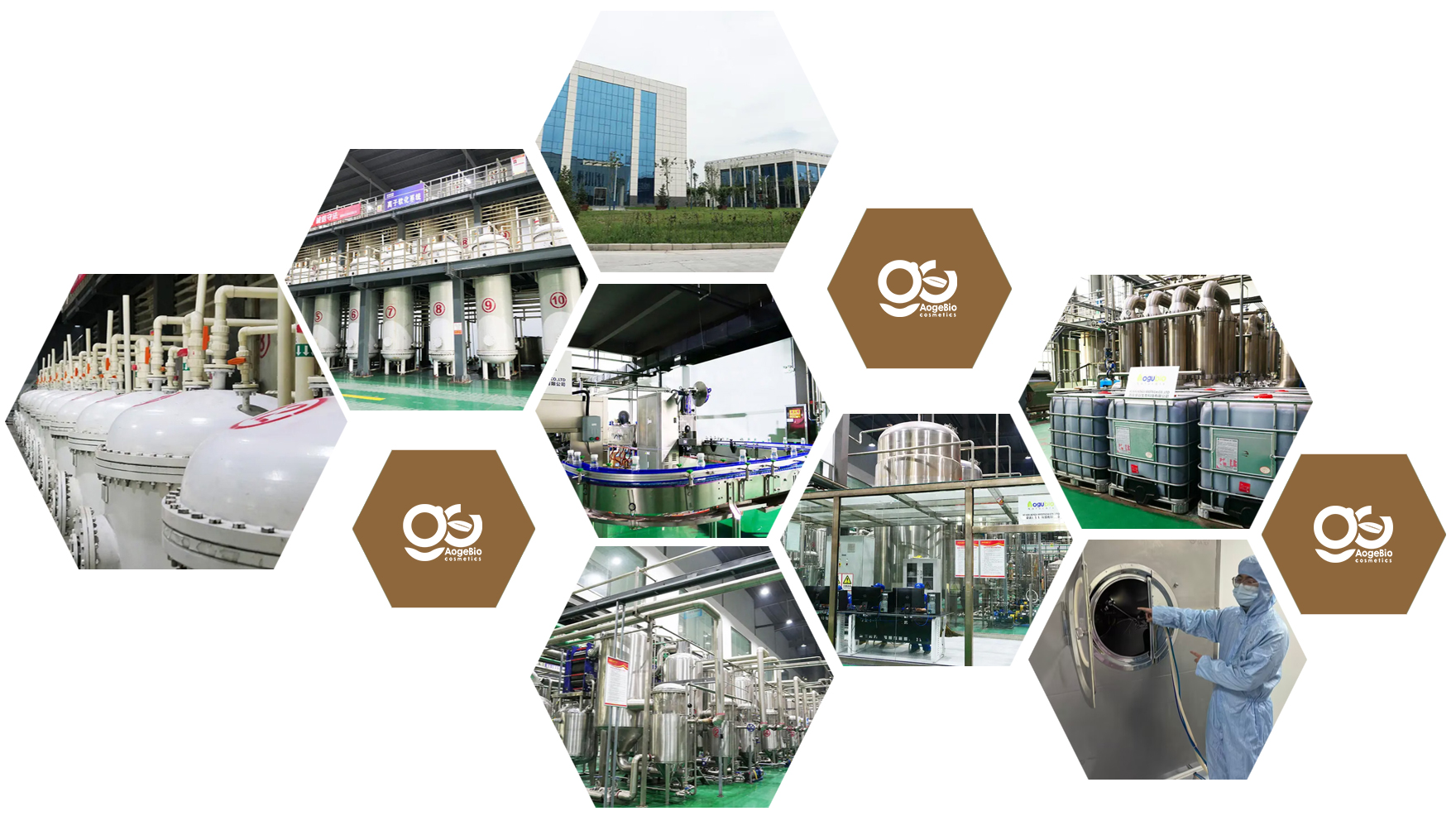
Founded in 2013 and headquartered in the prestigious high-tech zone of Xi'an, Xi'an Aoge Biotech Co., Ltd., along with its subsidiaries Xi'an Imaherb Biotech Co., Ltd. and Xi'an Nahanutri Biotech Co., Ltd., has established itself as a leading force in the cosmetics raw materials industry.
Our expansive cooperative factory, spanning 1,000 mu (approximately 165 acres), is equipped with state-of-the-art extraction technology. This advanced infrastructure allows us to manufacture a wide array of premium cosmetic raw materials. Our product line includes natural plant extracts specifically designed for organic cosmetics, as well as synthetic ingredients for high-end skincare formulations.
These raw materials serve as the foundation for a multitude of skincare, haircare, and makeup products, ensuring superior quality and efficacy throughout the entire production process.
Our in-house laboratory is equipped with cutting-edge instruments for rigorous quality control. We utilize UPLC and HPLC for analyzing active components, GC and GC-MS for detecting solvent residues, ICP-MS for identifying heavy metals, and GC/LC-MS-MS for assessing pesticide residues. Additionally, we employ HPTLC and IR for identification purposes, ELISA for determining ORAC values, PSL for evaluating irradiation residues, and conduct comprehensive microbiology tests. These measures guarantee that our raw materials adhere to stringent international standards.
At Aogebio, innovation, quality, and sustainability are the bedrock of our corporate philosophy.
We pour relentless efforts into research and development, constantly exploring novel raw materials and advanced manufacturing techniques to stay ahead in the dynamic cosmetics industry.
Rigorous quality control is embedded in every step of our production process, from raw material sourcing to final product delivery, guaranteeing that each item adheres to the most stringent international standards.
We actively embrace sustainable practices, striving to minimize our environmental footprint through eco-friendly production methods and responsible sourcing of all cosmetic raw materials.
This unwavering dedication enables us not only to consistently offer products of unparalleled excellence but also to contribute to the long-term, healthy development of the entire cosmetics industry.
Browse our full portfolio of high-performance cosmetic raw materials for professional formulation and blending.